
What if your parcel could travel from collection to delivery without joining a multi-stop network route? A direct courier London service is designed for that kind of journey: dedicated same-day transport for an individual parcel, rather than several sorting and transfer stages. It can suit a time-sensitive delivery, although London traffic can still affect the journey.
It’s sensible to want clarity before booking. “Direct” describes how the parcel is carried, not a promise that every journey will avoid delays. Knowing the difference between a dedicated trip and a network-based service can help you choose an option that fits your parcel and deadline.
This guide explains how direct courier delivery works in London, when it may be suitable and what to prepare for a smooth collection. You’ll find out which details to provide, including both addresses, parcel dimensions, access instructions and the day it needs to arrive. With that information ready, arranging a same-day journey is more straightforward.
Key Takeaways
- A direct courier London journey is a focused option for an individual personal parcel with a time-sensitive destination.
- Share clear collection and delivery details to help coordinate the journey and avoid unnecessary questions.
- Compare dedicated transit with a multi-stop network route to decide which approach suits your parcel and deadline.
- Have both postcodes, access instructions, contact numbers and parcel dimensions ready when arranging collection.
- SS Courier provides direct same-day transport for standard personal parcels, arranged by contacting the courier.
What does a direct courier in London mean for your parcel?
If a personal parcel needs to reach someone promptly, you may want it to travel from your door to theirs without being routed through a parcel network. A direct courier London service provides a dedicated collection-to-destination journey for an individual parcel, rather than sending it through network sorting stops. The courier collects it from the address you provide and takes it towards the recipient’s address.
A courier carries items from one place to another; you can read a general explanation of what a courier is. Here, “direct” describes the journey model. It doesn’t mean a guaranteed arrival time or protection from London traffic and other delays. “Same-day” means delivery is intended for that day, not that every parcel will arrive at a particular hour.
How is a direct courier different from a standard parcel network?
With direct transit, your parcel is assigned to a dedicated journey between the collection and delivery addresses. It isn’t sent through network hubs for sorting and onward routing. This gives the sender a clear point-to-point arrangement for that consignment.
Network services can use hubs, scheduled routes and different handling stages to move parcels. Their processes and timings vary, so the comparison isn’t identical for every service. The practical distinction is that a direct courier focuses on one parcel’s journey, while a network service moves parcels through a wider delivery system.
When might a direct courier in London be useful?
It may suit an individual personal parcel that matters on a particular day. For example, you might need to send a forgotten set of keys or clothing to a family member, or get an urgent birthday gift to its recipient. A point-to-point journey can be appealing when you want the parcel to travel as a dedicated delivery rather than wait within a multi-stage network.
A dedicated journey doesn’t remove the uncertainty of travelling across London. Road conditions can affect the journey, so same-day delivery shouldn’t be read as an exact arrival-time promise. Consider when the parcel needs to arrive and whether a direct trip suits its importance.
SS Courier provides direct same-day transport for standard personal parcels, with dispatch arranged by contacting the courier directly. To make the request clear, have the parcel details and both journey addresses ready.
How does a direct courier journey work across London?
A direct journey starts with the details of the parcel and the two points it needs to travel between. For an individual request, contact the courier, explain what is being sent and provide the collection and delivery addresses. Clear information helps establish the journey before collection is arranged.
- Share the parcel details: describe the standard personal parcel and give a useful indication of its size.
- Provide both addresses: include full collection and delivery addresses, postcodes and access instructions.
- Arrange collection: agree the collection for the request and make sure someone can hand over the parcel.
- Complete delivery: the parcel travels from collection towards the recipient’s address as a dedicated journey.
In short, direct same-day delivery moves from parcel details to collection, then onwards to the stated recipient, without network sorting stops.
What happens when you arrange the collection?
When you contact the courier, share the collection point, recipient’s full address and parcel details. Include the correct postcode for each location, along with information that will help the driver find the right entrance or reception point. For a block of flats, for example, include the building name, flat number and clear entry instructions.
Give a contact number for the person handing over the parcel and make sure they can be reached around the agreed collection. If access arrangements or the collection point change, share the update to avoid confusion at handover. The request is for an individual delivery, not an account-based business contract.
How do London postcodes affect the journey?
The collection and destination postcodes identify the two ends of the requested route. A journey might, for example, begin in Camden and finish in Croydon. Those place names illustrate how far apart London locations can be; they aren’t a statement about specific postcode coverage. Provide complete addresses as well as postcodes, since a postcode alone may not identify the exact entrance or recipient.
London’s last-mile deliveries involve local transport considerations. The Local Government Association’s report explores the challenges of last-mile delivery, including congestion. A dedicated route describes how the parcel is assigned for transit, but it can’t remove road conditions or guarantee a particular arrival time.
SS Courier arranges direct same-day transport for personal parcels in London and across locations including Chatham, Gillingham, Rochester, Dartford, Sittingbourne, Maidstone and Medway, as well as nationwide. Have the addresses and parcel details ready, then get in touch about a direct courier journey.
Direct courier or multi-stop delivery: which suits your parcel?
The right delivery model depends on how soon your parcel needs to arrive and whether a dedicated journey matters to you. A direct courier London service focuses on one consignment travelling between two addresses. A network service may consolidate parcels and move them through hubs or scheduled routes. Neither model is automatically right for every parcel.
| Factor | Direct courier | Multi-stop or network delivery |
|---|---|---|
| Route model | A dedicated point-to-point journey between collection and delivery. | Parcels may be consolidated, sorted at hubs or carried on scheduled routes. |
| Urgency | Designed for a same-day request when the parcel needs a focused journey. | May suit a parcel that can travel on a scheduled or next-day service. |
| Handling | Fewer network stages as part of the service model. | May involve more handling stages as the parcel moves through the network. |
| One personal parcel | Useful when an individual parcel needs dedicated transit between two addresses. | Can be suitable when direct handling and same-day delivery are less important. |
What does dedicated transit change for the sender?
With a direct service, the journey is arranged around the parcel’s collection and destination, rather than combining it with a wider flow of consignments. That can make the route easier to understand: the parcel is collected for a dedicated trip towards its recipient, without network sorting stops.
Fewer network handling stages are a feature of the model, not a guarantee against loss, damage or delay. A dedicated journey still takes place in real conditions, and the delivery day does not promise a particular arrival time. Choose it for the focused transit, not as a claim that every risk disappears.
Which parcels and situations are a better fit?
A same-day direct journey may suit a personal parcel such as a phone charger left at home or a book needed by a family member that day. It is useful when you want to arrange a focused trip between two addresses instead of waiting for a scheduled delivery.
If the parcel can arrive later, a scheduled or next-day network option may be more suitable. Decide based on the item, the collection and delivery addresses, and the day it needs to arrive. The comparison is about fit, not a blanket ranking: direct transit prioritises a dedicated journey, while network delivery can suit less urgent parcels.
What should you prepare before arranging a London direct courier?
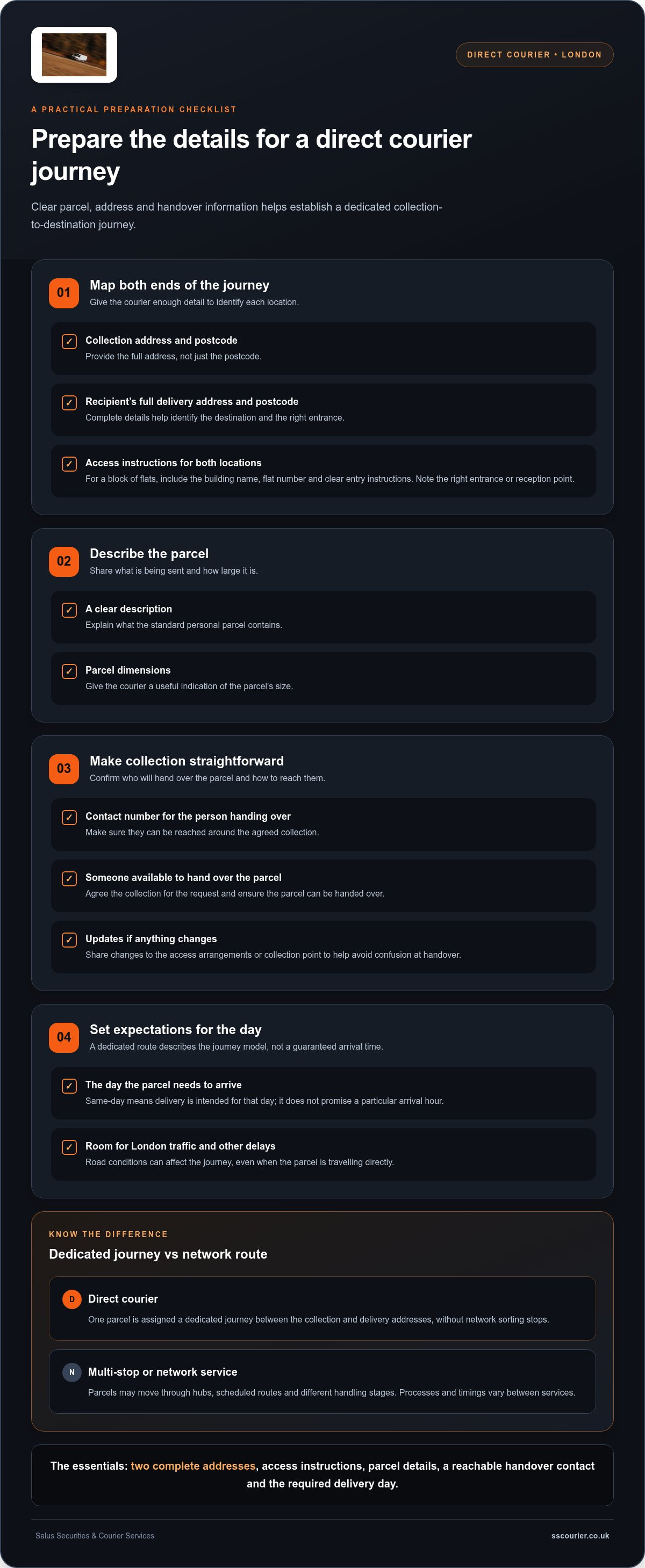
A little preparation helps make a direct courier London collection easier to coordinate. Before contacting the courier, gather the journey details and have the parcel packed and ready. Accurate information helps avoid confusion about where to collect, how to reach the sender and where the parcel needs to go.
Which collection and delivery details are useful?
Write down the full collection and destination addresses, including postcodes. Add details that help someone find the right entrance, such as a building name, flat number, reception point or access instructions. London addresses can be busy or shared by several buildings, so don’t rely on a postcode alone.
Use this checklist to prepare the request:
- Collection point: full address, postcode and clear access instructions.
- Delivery point: recipient’s full address, postcode and directions for reaching the handover location.
- Contacts: a name and reachable telephone number for the person handing over the parcel, plus the recipient or delivery contact.
- Timing: the day you need the parcel delivered and a brief explanation of why it’s time-sensitive.
- Parcel description: what it is, its approximate size and how it has been packed.
Make sure the collection contact knows the parcel is ready and can be reached around the agreed handover. If the recipient needs to meet the courier or provide access, share that information too. Clear contact details give both ends of the journey a practical point of reference.
How can you prepare the parcel for handover?
Pack the item securely in suitable packaging and label it clearly with the recipient’s details. A neat, closed parcel is easier to identify and handle than an item with loose contents or unclear labelling. Describe its approximate dimensions accurately, especially if its shape makes it larger than it first appears.
Mention relevant handling considerations when you describe the parcel. This helps explain what is being collected, but it isn’t a substitute for making sure the item is suitable for ordinary parcel transport. Keep the parcel accessible so the handover can take place without searching or repacking.
Once your addresses, contacts and parcel details are ready, contact SS Courier to arrange a direct same-day parcel collection.
Arrange a direct courier in London with SS Courier
SS Courier provides direct same-day courier transport for standard personal parcels. Each request centres on one parcel’s journey between a collection point and its recipient, rather than a business contract or account-based delivery arrangement.
A direct courier London request is easier to discuss when the route and parcel are clearly described. Sharing the requested delivery day explains your timing needs, but same-day describes the intended day of delivery, not a guaranteed arrival time. London journeys can be affected by conditions on the route, so don’t rely on an exact arrival time unless it has been agreed as part of the arrangement.
What to include in your courier enquiry
Have the key details ready before you contact SS Courier. They make the request clear and give the collection and delivery points useful context.
- Collection and delivery postcodes: include the full addresses too, with building names, flat numbers or directions needed to find each handover point.
- Requested delivery day: say which day the parcel needs to reach its recipient and briefly explain its time-sensitive context.
- Parcel dimensions: provide approximate length, width and height, along with a clear description of the item and its packaging.
- Contact details: give a name and reachable telephone number for the sender and recipient, or the people handling collection and delivery.
- Access information: mention entry instructions, reception arrangements or other details that could help someone reach either address.
Keep the enquiry focused on a standard personal parcel and its intended point-to-point journey. Accurate details can reduce avoidable questions about where to collect, who will hand over the parcel and where it should go. Make sure the parcel is packed and ready, and that the collection contact can be reached for the handover.
Take the next step with a direct parcel request
A dedicated journey can be a practical choice when an individual parcel needs to travel on the same day and you value a focused route between two addresses. The journey still depends on the request details and conditions on the day, so share the information clearly without assuming a fixed collection time or guaranteed arrival.
If you have a standard personal parcel to send in London, contact SS Courier to arrange your direct courier request. Provide the postcodes, delivery day, parcel dimensions and access details so the journey can be discussed with the relevant information to hand.
Make your next parcel journey straightforward
A direct courier offers a dedicated journey between collection and delivery, rather than sending your parcel through network sorting stages. It can suit a time-sensitive personal parcel, while a scheduled option may be enough if the delivery is less urgent. Same-day describes the intended delivery day, not a guaranteed arrival time.
Before arranging a direct courier London request, prepare the full addresses and postcodes, contact details, access instructions and an accurate description of the parcel. These details help make the collection and destination clear from the outset.
SS Courier provides focused direct same-day transport for standard personal parcels. You can arrange a dispatch by contacting the courier directly and sharing the requested journey details. If a dedicated trip suits your parcel, contact SS Courier to arrange a direct parcel delivery.
Frequently Asked Questions
What is a direct courier in London?
A direct courier in London carries a parcel on a dedicated journey from its collection address to its destination, rather than routing it through network sorting stops. It can be a practical choice for an individual personal parcel that needs focused transit. SS Courier provides same-day transport for personal parcels across London, Chatham, Gillingham, Rochester, Dartford, Sittingbourne, Maidstone and Medway, as well as nationwide. Explain the journey and intended delivery day when arranging a request.
Is a direct courier the same as a same-day courier?
Not necessarily. “Direct” describes the route model: a dedicated journey between collection and delivery. “Same-day” describes the intended delivery day. A same-day service may use different delivery models, while a direct journey might not always be scheduled for same-day delivery. SS Courier provides direct same-day transport for standard personal parcels. Same-day describes the intended day, not a promise of arrival at a particular time.
How does a direct courier collect a parcel in London?
The sender contacts the courier and shares the collection address, destination address and parcel details. They can also provide postcodes, access instructions and reachable contact numbers for the handover points. These details clarify where the parcel is collected and where it needs to go. The collection is arranged around the individual request, rather than through an account-based business contract or an online portal requirement.
Can I use a direct courier for one personal parcel?
Yes. A direct courier can be arranged for an individual standard personal parcel, such as a forgotten personal item or an urgent gift travelling between two addresses. SS Courier focuses on individual parcel requests, with dispatch arranged by contacting the courier directly. Share the parcel’s approximate size and the collection and delivery details so the journey is clear. This is a personal parcel service, not a commercial contract arrangement.
Does direct courier delivery mean the parcel will arrive immediately?
No. “Direct” means the parcel is assigned a dedicated journey between the collection and delivery points, not that it arrives immediately or at a guaranteed time. Same-day delivery means the intended delivery day is the day the parcel is sent. Road conditions and the distance between addresses can affect the journey. Give the courier the delivery day you need and don’t treat it as a specific arrival-time promise.
What information do I need to arrange a direct courier?
Prepare the full collection and delivery addresses, both postcodes, access instructions and contact details for the people involved in each handover. Describe the parcel, including its approximate dimensions and packaging, and state the requested delivery day. Mention relevant handling considerations. Clear details help avoid confusion about where the courier needs to go and who will be available to hand over or receive the parcel.
Is a direct courier better than a parcel network?
Neither option is best for every parcel. A direct courier may suit an individual parcel that needs a focused, same-day journey between two addresses. A parcel network may suit a less urgent delivery that can move through scheduled routes and sorting stages. Choose based on the parcel, the collection and destination addresses, and the day it needs to arrive. Direct transit reduces network handling stages by design, but doesn’t guarantee against delay or loss.


